 Introduction
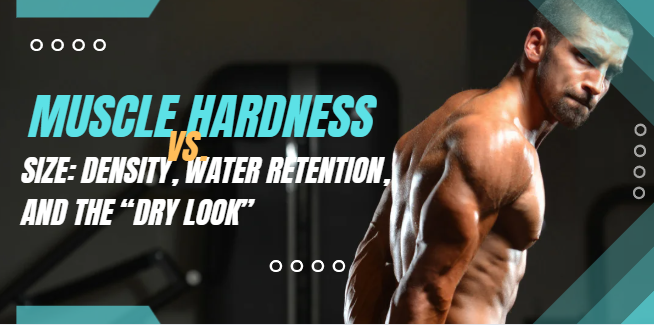
Not all muscle looks—or feels—the same. Two lifters could have similar body weight and measurements, yet appear very different: one might look soft and bloated, while the other looks sharp, tight, and “granite-like.” The difference lies in muscle hardness, sometimes called “density” or the “dry look.”
Muscle hardness refers to how firm, compact, and defined muscles appear at rest—not just due to low body fat, but from the internal structure, fluid balance, and maturity of the tissue.
This article dives into what causes muscle hardness, how it differs from sheer size, and how you can influence it through training, diet, and conditioning.
What Gives Muscle That Hard, Dense Appearance?
Key Components of a Dense, Hard Look
Mature contractile tissue: Well-developed myofibrils and connective structure
Low subcutaneous and extracellular water: Minimal blurring or puffiness
Tight, “shrink-wrapped” skin over lean muscle
Low intramuscular fat & minimal edema
Often seen in experienced lifters and those managing estrogen or using DHT-based compounds
Even with identical muscle mass, the appearance can differ drastically depending on how much “soft matter” (water, fat, glycogen volume) overlays or infiltrates the muscle.
A study in older adults found that muscle density correlated more strongly with strength and physical performance than mere muscle size did. PubMed+1
Size vs. Density: The Big Picture
Myofibrillar vs. Sarcoplasmic Hypertrophy
Myofibrillar hypertrophy builds contractile proteins (actin, myosin)—this contributes to a denser, stronger tissue.
Sarcoplasmic hypertrophy increases the volume of non-contractile elements (glycogen, mitochondria, fluid), which gives size—but not necessarily hardness. Wikipedia
You can have large muscles that feel “softer” or “full” if much of that size comes from fluid and storage rather than contractile density.
Tissue Tension & Hardness Relationship
There’s physiological support that muscle hardness correlates with muscle tension. In studies with isolated muscle tissue, hardness scaled with both passive and active tension. PubMed
Therefore, a muscle with more internal tension or structural rigidity tends to feel and look firmer.
The Role of Skin, Fat, and Water
Even a “hard” muscle can appear soft if:
Subcutaneous fat is too thick
Water retention (under the skin) is high
Inflammation causes temporary swelling
Skin tightness and minimal edema are essential for the appearance of hardness.
What Affects Muscle Hardness in Real Life
Training Age & Strategy
Years (or even decades) of lifting heavy, progressive loads promote mature fiber development, connective remodeling, and structural tightness.
High-volume “pump” training is great for growth, but does less for density unless paired with heavy, low-rep work over time.
Hormones & Water Retention
Estrogen and aldosterone drive sodium retention and extracellular water—many “soft” or “bloated” physiques stem from this.
DHT-based compounds (e.g., Masteron, Winstrol, Proviron) are known to deliver a drier, tighter look.
Drugs with strong aromatization (like testosterone, Dianabol, or Anadrol) commonly contribute to puffiness, especially early in a cycle.
Body Fat & Skin Thickness
Even small layers of fat can mask muscle texture.
Some body parts (hamstrings, lower back, glutes) naturally carry more water/fat, making “density” uneven.
Glycogen, Inflammation & Pumps
Loading carbs floods muscles but can make them appear smooth rather than sharp.
Recent training-induced inflammation or pump-induced swelling can temporarily soften appearance (that’s why many competitors avoid training major body parts right before show day).
How to Enhance that Carved, Dense Look
Here’s how to shift your physique toward hardness, not just mass:
Train heavy for maturity
Use lower rep ranges (4–10) with heavy compound work for years. Over time, this builds real structural density.Control estrogen and water
Use aromatase inhibitors (if on cycle) or adopt methods to suppress excess water retention.Lose body fat slowly
Too aggressive cuts flatten muscles and kill fullness. Aim for stripping fat while preserving glycogen and structure.Use “hardening” compounds responsibly
DHT derivatives (Masteron, Winstrol, Proviron) are often used in pre-contest phases to enhance tightness. Use them carefully and temporarily—risks are real.Flush extra water strategically
Lower sodium gradually before a peak. Use natural diuretics (dandelion root, caffeine) or prescription diuretics with care.Focus on structural integrity
Work on connective tissue strength, posture, tendon health, and fascia. A stable muscle frame displays hardness better.
As one seasoned lifter put it:
“I wanted to look like I was carved from stone. Over the years I realized it wasn’t about bigger arms—it was about tighter structure and less fluff.”
— Aaron G., veteran competitor
Another coach adds:
“When I prep athletes, I shift focus away from volume toward intensity and water control in the final phases. Hardness beats bulk on stage.”
— Coach Elena V., Contest Prep Specialist
Key Takeaways
“Hard” muscle isn’t just about size—it’s about internal density, fluid balance, and maturity.
Density correlates more closely with function than sheer volume. PubMed+1
Your training, diet, fat levels, and hormonal state all determine whether muscles appear soft or granite-hard.
Achieving the “dry look” demands long-term commitment, strategic drug/diet use (if applicable), and finesse in water and sodium control.
Was this article helpful?
That’s Great!
Thank you for your feedback
Sorry! We couldn't be helpful
Thank you for your feedback
Feedback sent
We appreciate your effort and will try to fix the article